
Marketing Tips from The Super Bowl Ads
Spending 7 million dollars for a 30-second ad – you’ll probably never have to do that, BUT Super Bowl advertisers did. Most of the ads were funny because humor sells, so learn from what they did and see if you can apply it to your business. Here’s my Marketing Tips from the Super Bowl Ads:
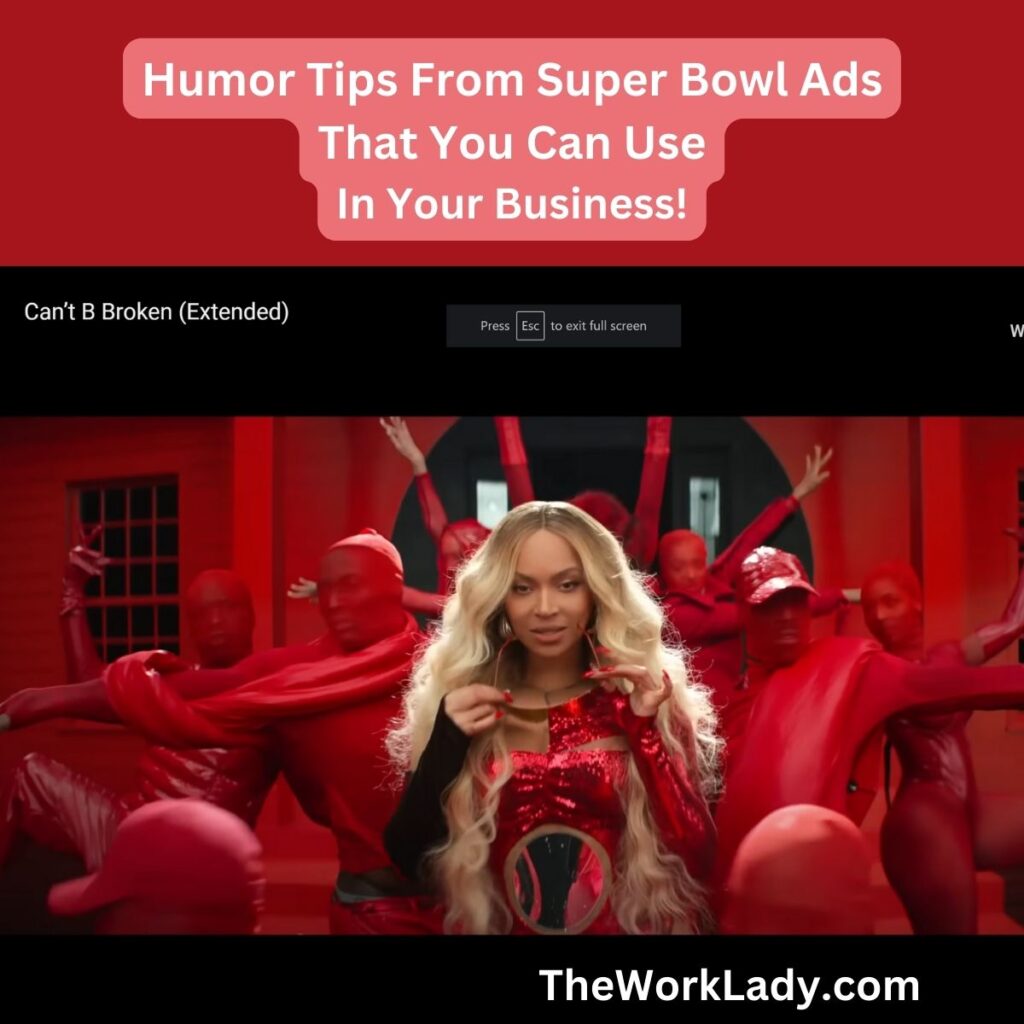
1. Beyonce –
we all know she can break the Internet when she drops a song, so Verizon took advantage of that and made a great (and funny) analogy with her trying to break Verizon. What major event (like breaking the internet) can you associate with your product or service? Then show how your product or service can stand up to it. Analogies are fast ways to add in some humor.
2. Christopher Walken –
is one of the most imitated celebrities in the world – trust me, I worked at comedy clubs and saw hundreds of up-and-coming comics try to mimic him as if no one had ever done it before! BMW wants you to buy their car, not an imitation, so they had people trying to imitate Christopher Walken and doing it badly. They made their point in a funny way about how imitations are NOT as good as the real deal. What do you NOT want people to do with your product? Show people why they should not do it.
3. After quarantine,
people tended to forget about using Uber Eats, so their funny take on remembering to order from them included celebrities. Jennifer Aniston started off saying that in order to remember something, you have to forget something else to “make room” for the new info. Does your company or product have a feature that people forget? Make a list of how people remember things (singing it, rhymes, mnemonics, repetition, story-telling, flashcards, etc . . . ) and make a funny twist on that memory technique or make up a new, silly memory technique.
4. State Farm’s commercial
with Arnold Schwarzenegger mispronouncing the word “neighbor” in their slogan was funny. Of course, you have to be careful making fun of a mispronunciation, but is there a word in your product that people mess up or confuse or don’t understand? Get it to stand out by making up a funny definition or pronunciation of it. Using your industry’s celebrities or highly visible people to try to figure it out is a nice way to keep your product in front of people.
5. And one note of caution:
The Duncan donuts commercial got a lot of thumbs up – I believe it was a callback to last year’s commercial. BUT since I didn’t remember last year’s commercial, it wasn’t that great for me. If you want to do a callback (referring to something done in the past) or a reference, make sure it’s recognizable. At my event last week, where I talked about using humor, an attendee gave me a great example of when he ALMOST opened a speech with a reference to a movie. It was a movie he LOVED, but he found out no one else had either seen it or remembered much about it. When he asked me about the movie, I hadn’t seen it either. He ditched the reference and saved himself a lot of blank stares.
There are many simple ways to incorporate humor into your message that gets overlooked. Have some fun and give it a whirl! It won’t break the bank, but wouldn’t it be cool if your message broke the internet!
Check out my joke writing website for more ideas on, well joke writing
And other tips for comedy writing are in this blog, such as this post.
The Super Bowl and Your 7 Million Dollar Education
I say “Super Bowl” you say . . . “Commercials!” That’s right, people who love and hate football associate commercials with the big game because THE COMMERCIALS ARE FUNNY.
In 2023, the cost of a 30-Second Ad Spot was around $7 million and the ads were mentioned over 300,000 times (1300 per minute) on Twitter during the game. You can’t get that kind of engagement if you’re Elizabeth Taylor (She’s been married 8 times.)
So why aren’t people using more humor in their marketing?
Afraid? Don’t know how? Easier to do the same ‘ole thing? PICK ONE!
But these days you shouldn’t shy away from making your message a little entertaining – people kind of expect it and you’re competing with a lot out there!
Humor is a muscle, and you’ve got to practice looking for it. The Super Bowl is a GREAT opportunity to learn from the pros, without spending 7 million bucks! So I challenge you to not just laugh at the commercials, or whatever it is that cracks you up, but to take a minute and figure out WHY it’s funny. You might be able to use that concept for your business.
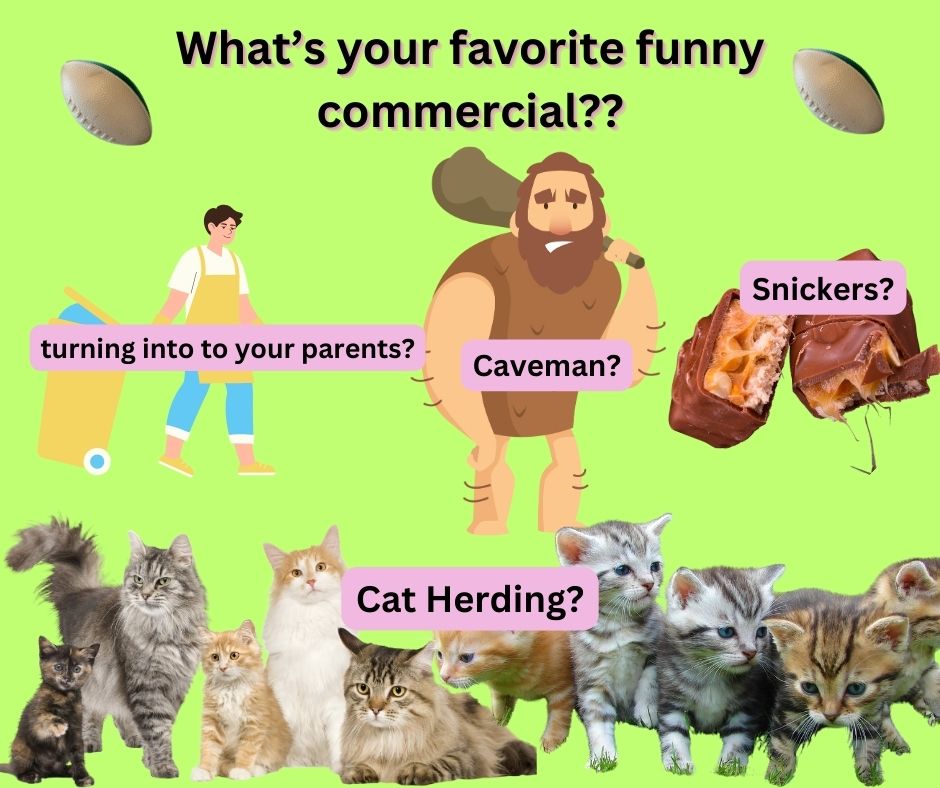
For example, there was cat herding (my favorite). This commercial was based on the idiom “It’s like herding cats.” So ask yourself, is there an idiom that works with your product or service? Or Progressive’s “turning into your parents” commercials. While not strictly a Super Bowl commercial, as yourself “is there something your clients or potential clients DON’T want?”
Don’t miss a golden opportunity to get a 7 million dollar education FOR FREE by paying attention to funny Super Bowl ads.
Here’s my recap and analysis from last year’s Super Bowl commercials – https://www.comedywriterblog.com/2023/02/
Have fun with it and see where it goes! And check out my website for some of MY humor TheWorkLady.com
Jan
(I watch the game because I love football . . . the commercials are the icing!)
Funny Humor Article Titled “Mom’s Genius Idea”
My latest humor article is out titled “Mom’s Genius Idea” Is about a shortcut my mom did when we were kids. Lots of humor is pulled from our early years, so when you’re looking for the humor, dig deep and think of routine things that happened at your house that may not have happened at other people’s houses.
Below is a short except and link to the rest of the article.
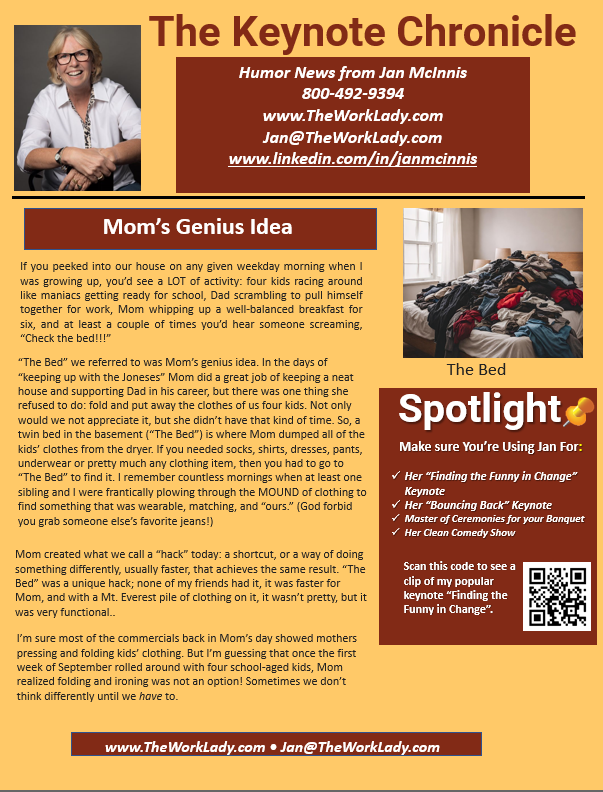
If you peeked into our house
on any given weekday morning when I was growing up, you’d see a LOT of activity: four kids racing around like maniacs getting ready for school, Dad scrambling to pull himself together for work, Mom whipping up a well-balanced breakfast for six, and at least a couple of times you’d hear someone screaming, “Check the bed!!!”
“The Bed” we referred to was Mom’s genius idea. In the days of “keeping up with the Joneses” Mom did a great job of keeping a neat house and supporting Dad in his career, but there was one thing she refused to do: fold and put away the clothes of us four kids. Not only would we not appreciate it, but she didn’t have that kind of time. So, a twin bed in the basement (“The Bed”) is where Mom dumped all of the kids’ clothes from the dryer. If you needed socks, shirts, dresses, pants, underwear or pretty much any clothing item, then you had to go to “The Bed” to find it. I remember countless mornings when at least one sibling and I were frantically plowing through the MOUND of clothing to find something that was wearable, matching, and “ours.” (God forbid you grab someone else’s favorite jeans!)
Mom created what we call . . .
Check out other posts from my comedy writing website by clicking here!
Check out my website here TheWorkLady.com
HAVE A GREAT WEEKEND!
Comedy Writing Gigs part 3
Hilarious jokes are all set – you’ve got some samples of jokes you’ve written and some real live people – radio, TV, comedians, etc. . who will vouch for you that you’re, or at least the jokes you write, are funny! So where do you now go to actually write...
Watching Comedy
Comedy burnout? Does that really happen? Kind of! When I started out, I think I was performing in a comedy club or sitting in the audience of a comedy show just about every night for the first 2 years. And then I quit my job and kept on a steady stream of...
B. Research Techniques
What Have You Laughed About Recently?
In thinking about this comedy blog, I asked myself, “what have I laughed about recently?” Luckily as a comedian, I’m always looking for humor, and so I had a big list of funny things from just the past 7 days. Life goes by way too fast which means it’s...
Humor in Pain
Funny jokes come out of pain. . . if you can stay present and see the humor. When we’re sick, we don’t feel like laughing, but that’s precisely the time we need to pay attention to finding the humor – because you’re looking at life from a different...
Take The Road Less Traveled
As for funny things, that's not only the name of a popular book, but it's a philosophy for finding humor. One of the shows I performed at this week was for 600 women at a church. The crowd was so big that they turned the men's room into a ladies room. . ....
Humor Writing for Business or Personal
Humor writing 90 second clip
C. Humor Delivery
Dialing For Dollars
In my line of work, there's a lot of cold calling. Sure I get work through agents and bureaus, but the majority of my work i get through "dialing for dollars." And while you may not need to make cold calls to bring in an income, you still will need to...
Judging Jokes
There aren’t many hard and fast rules in comedy, but one comedy rule you can’t get around is that comedy is subjective. . . everyone has a different idea of what’s funny and what’s not. For example, a friend of mine just had a liver transplant. He’s okay,...
Remembering Your Funny Jokes
So you’ve worked and worked on some killer material. Great! But you’ve got to REMEMBER the joke in order to, well, get people to laugh. I have a couple of memory techniques that I use. Say it out loud FAST. Run through your jokes fast, so that you can get...
Humor About NOT Using Your Product
Lots of marketing campaigns use humor toting the benefits of using a product or service, but what developing humor about what happens if people DON'T use your product or service? This Hilarious ad from Southwest Airlines (below) promoting their hotel site is a GREAT...
5 Things Not to Say to a Comedian
People think they can say ANYTHING to a comedian and why not? They're a comedian, they can take a joke. Right? Well, sure, but there are still things that you should NOT say to a comedian. Why? Because number one, these things are rude and number two we hear them all...
Comedy Gold: The questions are you asked
questions you’re constantly asked is a good source for humor. Don’t get annoyed; turn them into jokes
D. Appropriate Humor
A Comedian on Being Genuine
Joke material and funny stuff these days is all around us. . .especially if you’re a comedian and you write political humor. Between “alternative facts” and bringing your own cheering section to a briefing, the current president is opening himself up to a...
Funny Jokes
Political Humor
I chatted on this comedy blog infrequently in the past couple of months. . .okay not at all. I’ve been in the middle of some comedy projects that are exciting but taking more focus than I can handle. So for funny this week, I thought with all the politics...
LETTING GO!!
Letting Go . . .Of joke ideas that aren’t working that is. And this is a hard one because, as we comics say when we come up with an idea for a joke we just know “there’s something there.” I’ve been working on a joke about “tribute bands” – you know bands...
Joking With Names
Sometimes the humor is not in researching the subject thoroughly, but rather in stepping back and looking at the big picture – their name. Companies name themselves and their products all sorts of whacky things, for all sorts of whacky reasons. Watch any...
Humor in Business is a Billion $$$ Business
Can you spend 6.5 million in 30 seconds???? Well the Super Bowl advertisers did! That's what an ad costs in 2022. And according to a USA Today Survey, the top ad was Rocket Mortgage's ad starring Barbie. A link to the ad is below. I've also noted below the three...
Comedy and the Olympics. . . the humor I see.
humor in the winter olympic games
G. Topical Jokes
Comedy Writing gigs part 2 is up next
Welcome to part 2 of comedy writing opportunities. In my last blog I mentioned that you should network at comedy clubs. Yes, Comedy clubs are great networking avenues, but I also suggest networking to others who are in need of comedy material every,...
Wedding Toast Jokes For Laughs
In previous blogs I’ve talked about using topical jokes to bring in some current humor, and I’ve got a great example of it. I’ve started writing topical jokes for a wedding toast website for the best man:...